從老照片中找到新發現!
江國興研究團隊首次觀察到罕有類型超新星的前身
「沃爾夫–拉葉星」
天文所江國興教授及計畫研究團隊利用哈伯太空望遠鏡於2005年所拍攝的舊照片中,率先發現一顆明亮的藍色星星,其位置非常接近一顆近期爆發的罕有類型超新星,這顆藍色亮星極有可能就是該超新星爆炸前的恆星原形。這項全球首度發現的重要研究成果已於2013年9月20日於國際頂尖的「天文物理期刊通訊」(The
Astrophysical Journal Letters)上正式發表。
2013年6月16日,「中期帕洛瑪瞬變現象工廠」(intermediate Palomar Transient Factory)
巡天計劃,發現到一顆被命名為iPTF13bvn的超新星 。這顆超新星位於NGC
5806星系,距離地球八千萬光年。由於它的光譜上沒有氫譜線,因而被分類為Ib型超新星,這型的超新星屬於較為罕見的一型。計劃研究團隊成員之一的國立清華大學天文研究所江國興教授及其研究生李君樂,檢查8年前(2005年)由哈伯太空望遠鏡拍攝屬於該天區的高解析度照片,發現到一顆疑似該超新星前身的明亮藍星。但要證明它真的是這顆超新星的前身,必須先將兩者的影像位置對準。藉由位於夏威夷口徑10公尺的凱克「自適應光學系統」望遠鏡取得的高解析度照片,團隊成功得到超新星的準確位置。在經過其他團隊成員反覆驗證後,終於證實該藍星極有可能為iPTF13bvn的前身,這也是全球首次觀察到Ib型超新星爆炸前的真實面貌。
經過仔細的探究,該明亮藍星被鑑定為一種稱為「沃爾夫–拉葉星」的恒星。這種恆星是由大質量的主序星演化而成,表面溫度十分高,因而呈深藍色。雖然天文學界一般相信Ib型超新星是由沃爾夫–拉葉星爆炸而成,但一直缺乏觀測上的證據。這次發現可以說是第一次提供了最有力的證據支持整個理論,因此特別具有重要的意義!
除了發現超新星前身,清大的研究團隊更透過美國太空總署的雨燕 (Swift)
天文觀測衛星成功接收到由該超新星發出的X光。其成果將有助於了解超新星爆炸所產生的衝擊波與星際介質兩者間的劇烈互動。
「中期帕洛瑪瞬變現象工廠」巡天計劃是由加州理工學院領導的國際合作計畫,成員包括來自美國、瑞典、以色列、日本及台灣聯合大學系統
(中央、交通、清華及陽明)
的「探高」TANGO計畫。在國科會的補助下,「探高」計畫的天文學家可以使用位於美國加州帕洛馬山天文台的1.22公尺巡天自動望遠鏡研究宇宙的光變現象,尋找超新星正是這個計畫的主要目標之一。
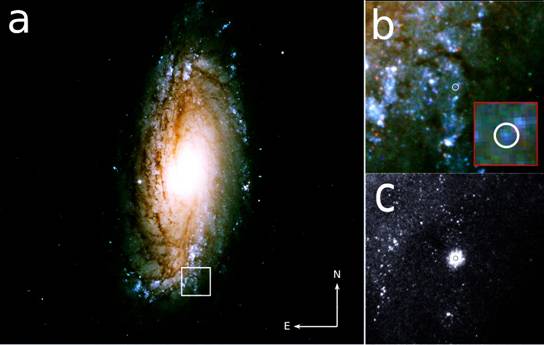
Progenitor Star of a Stellar Explosion Found
From a series of old images by the Hubble Space telescope (HST) taken in
2005, astronomers from National Tsing Hua University in Taiwan, as well
as the international project iPTF, find the progenitor star of a newly
discovered stellar explosion, known as Type Ib supernova, for the first
time in the history of astronomy. The unprecedented discovery has been
published in The Astrophysical Journal Letters.
The iPTF project is a scientific collaboration between Caltech, Los
Alamos National Laboratory, the University of Wisconsin, Milwaukee, the
Oskar Klein Center in Sweden, the Weizmann Institute of Science in
Israel, the TANGO Program of the University System of Taiwan, and the
Kavli Institute for the Physics and Mathematics of the Universe in
Japan. It was built on the legacy of the Palomar Transient Factory (PTF),
designed in 2008 to systematically chart the transient sky by using a
robotic observing system mounted on the 48-inch Samuel Oschin Telescope
on Palomar Mountain near San Diego, California. This state-of-art,
robotic telescope scans the sky rapidly over a thousand square degrees
each night to search for astronomical objects whose brightness changes
over time scales from hours to days. One important type of these
transients is supernovae, massive exploding stars at the end of their
life time.
Based on observations obtained with iPTF on 16 June 2013, the scientific
collaboration discovered a supernova, called iPTF13bvn, in the nearby
galaxy NGC 5806, located in the constellation Virgo about 80 million
light years away from us. Based on a series of follow-up spectroscopic
observations, the supernova is classified as Type Ib because there is no
hydrogen feature in the optical spectrum.
Shortly after the supernova explosion, the team including Professor
Albert Kong and his graduate student Ray Li, from National Tsing Hua
University (member of the University System of Taiwan), announced that a
possible progenitor star was found in the pre-explosion high-resolution
HST archival images. Following the initial alert, high-resolution
optical images of the supernova were obtained with the 10m Keck I
telescope together with an adaptive optics system (a special technique
to improve the spatial resolution by counteracting for the distortions
caused by the atmosphere). The team successfully refined the explosion
position and confirmed the progenitor candidate identified in the HST
images. The results combined with multi-wavelength follow-up
observations indicate that the progenitor is consistent with a Wolf-Rayet
star with a radius of a few times of our Sun. Wolf-Rayet stars are very
hot star stars that are 10 times more massive and thousands of times
brighter than the Sun, and that are losing mass rapidly by means of very
strong stellar winds.
Although Wolf-Rayet progenitors have long been predicted for Type Ib
supernovae, no concrete observational evidence has been found. The
progenitor discovery of iPTF13bvn fills the gap between theory and
observation.
The team members from Taiwan also discovered the X-ray emission from the
supernova by using NASA’s Swift X-ray Telescope. X-rays from supernova
explosion are difficult to be detected because they are usually faint.
By accumulating the X-ray data for nearly a month, the Taiwanese team
finally found the trace of the X-rays. The results will provide
important information how the shock wave of the explosion interacts with
the interstellar medium.