Fig. 1. Prof. Raynien Kwo (middle), Dr. Ssu-Yen Huang (2nd left), and some PhD students in the research team of Prof. Chia-Ling Chien, at Verdan Center, Deleware, USA.
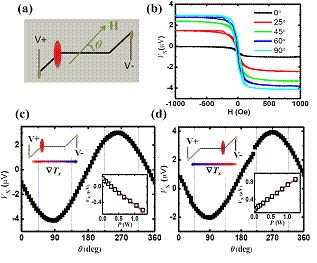
Fig. 2. (a) Schematic diagram of a Py wire sample for the thermal measurement with voltage leads on two sides, heat source indicated by the large oval, and magnetic field direction at angle (b) field dependence of thermal voltage at different angle. Angular dependence of thermal voltage when heater is on the (c) left, and (d) right of the wire. Insets show power dependence of thermal voltage.
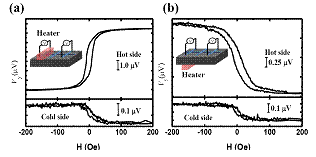
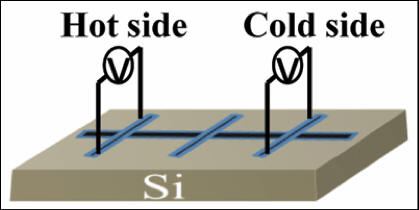
Fig. 3. Field dependence of thermal voltage on the hot side (top panel) and cold side (bottom panel) of Hall bar Py sample with heater placed on (a) top; and (b) bottom of the sample.
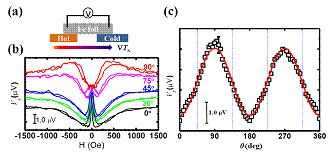
Fig. 4. (a) Schematic sideview of a suspended Fe foil sample for the intrinsic spin-dependent thermal transport measurement (b) Field dependence of thermal voltage when the field is applied at different angle. (c) Angular dependence of saturated thermal voltage with the solid curve of cos2θ.
Important Breakthroughs in Spin Caloritronics Studies
|
Supported by the Dragon Gate project of the National Science Council of Taiwan, an international research team including Prof. Raynien Kwo of National Tsing Hua University Department of Physics, Dr. Shang-Fan Lee of the Institute of Physics, Academia Sinica, Prof. Chia-Ling Chien and Dr. Ssu-Yen Huang of the Department of Physics and Astronomy, Johns Hopkins University have made very important breakthroughs in “Spin Caloritronics” studies. Their work was just published in Physical Review Letters, 107, 216604, 2011. It was also highlighted in Physics Synopsis of APS(http://physics.aps.org/synopsis-for/10.1103/PhysRevLett.107.216604). |
Recently, the new term “Spin Caloritronics” is emerged to study the spin dependent transport along with heat transport especially for ferromagnetic materials. Meanwhile, the thermal properties of nanostructures have become a fundamental topic due to the necessity of heat reduction in increasingly smaller electronic devices. As a result, “Spin Caloritronics” was introduced as a key solution for the thermodynamic bottleneck, that is, the small-sized charge-based logic devices cannot be operated reliably because the Joule heating generated by charge current would exceed the tolerance level very quickly. “Spin Caloritronics” provides promising solutions to these problems by employing heat current based on electron spin and reducing power consumption.
The recent discovery of the Spin-Seebeck effect has pushed the discipline of “Spin Caloritronics” into the spotlight and opened up a new route of exploiting the spin dimension in electronic transport. The Spin-Seebeck effect, referring to the generation of spin 'voltage' as a result of a temperature gradient, has been observed in ferromagnetic metals, semiconductors as well as insulators. However, complexities emerge when the effect occurs in a film that sits on top of a substrate, with several studies suggesting that the observed spin effects may be a consequence of the thermodynamics of the substrate.
In addition to fundamental electronic charge, electron has an intrinsic property of spin which gives a new degree of freedom. The difference in the chemical potentials of the spin-up and the spin-down electrons can cause a pure spin current. Spintronics is the science and technology using electron spin to develop new devices and improve technological functionalities. One of the main challenges of Spintronics is the creation, manipulation, and detection of spin current.
An alternative method was suggested recently by the discovery of the Spin Caloritronics ─ a thermal gradient in a ferromagnetic metal, semiconductor or insulator was found to generate pure spin current over long distances at room temperature. This raises exciting new possibilities for new spintronic devices. One fundamental question is how the spin accumulation survives for a distance much longer than the spin diffusion length. Since the observed phenomena are so similar and hard to be distinguished between different materials, the physics of Spin Caloritronics effects seem to be the same. Further verification of the mechanism is required.
Dr. Ssu-Yen Huang from Taiwan, currently a postdoc at National Tsing Hua University and Johns Hopkins University, used patterned ferromagnetic thin film to demonstrate the profound effect of a substrate on the spin-dependent thermal transport. With different sample patterns and on varying the direction of temperature gradient, both longitudinal and transverse thermal voltages exhibit asymmetric instead of symmetric spin dependence. Interchanging the heater and the heat sink causes a sign change of in-plane temperature gradient, the same asymmetric dependence still remains. This unexpected behavior is due to an out-of-plane temperature gradient imposed by the thermal conduction through the substrate. To demonstrate perpendicular temperature gradient, they have made measurements on the same sample, one with the heater placed on the top side of the substrate and the other with the heater placed on the bottom side. The position change of the heater caused a sign change of the thermal voltage at the hot sides, where the heater is placed, but not at the cold side. Since most Spin Caloritronics studies to date utilize thin films on substrates, the issue of the perpendicular temperature gradient must be addressed. Huang et al. have used a narrow strip of a thin Fe foil suspended at two ends by the Cu blocks, which provide an unequivocal temperature gradient. The behavior of thermal transport, instead of an asymmetric behavior as previously encountered in thin films on substrates, is now completely symmetric. Only with substrate-free samples have we determined the intrinsic spin-dependent thermal transport. The effect is sensitive to magnetic fields, and is promising for eventual applications.
Reference
[1] S. Y. Huang, W. G. Wang, S. F. Lee, J. Kwo, and C. L. Chien, Intrinsic Spin-Dependent Thermal Transport, Phys. Rev. Lett. 107, 216604 (2011).
For more information, please contact:
 |
Kwo, Ray Nien |