PostDoc and graduate students are welcome to join us
Research in AMO physics, Laser physics and Optics!!!

NEWS!
2020.6 Observing macroscopy quantum tunnelling of Bose Einstein Condensate
2020.5 Unexpected Rydberg state interaction inducing cold atom trap loss!
More information...
BEC Quantum Gases and Analog Gravity Experiments
Our laboratory uses ultracold rubidium Bose-Einstein condensates (BECs) as a primary research platform. A BEC is a macroscopic matter wave formed when a large number of atoms occupy the same quantum state. It is therefore not only an important system in ultracold atomic physics, but also a quantum fluid that can be directly observed, manipulated, and measured. By using optical dipole traps and magnetic traps, we prepare highly coherent condensates and study the non-equilibrium dynamics of quantum many-body systems through rapid changes of trapping potentials, controlled free expansion, modulation of transverse confinement, and analysis of density correlations.
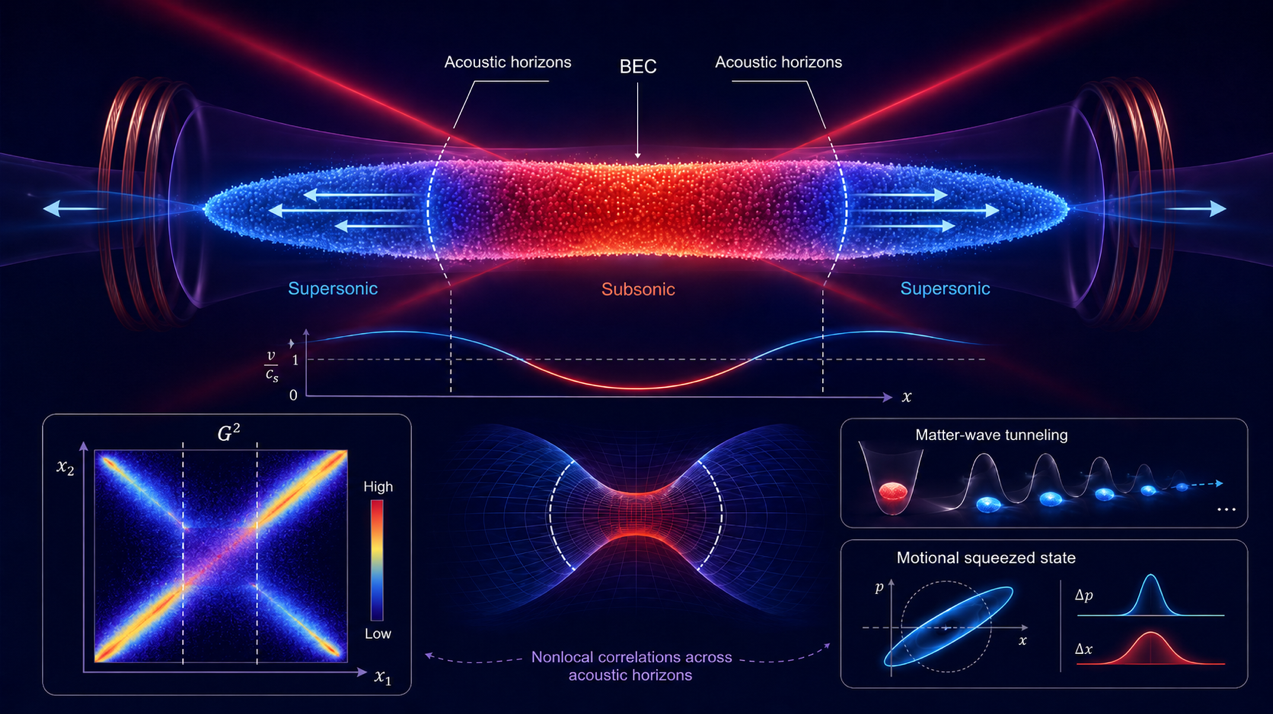
One of the central research directions of our laboratory is to use freely expanding BECs to create an "analog gravity" acoustic spacetime. When the flow velocity inside the condensate exceeds the local speed of sound, phonons experience a causal boundary analogous to a black-hole horizon. We have developed a supersonic-subsonic-supersonic double-horizon structure, in which two acoustic horizons are connected by a central subsonic region. This forms a multi-horizon quantum-field platform that can be studied in the laboratory. Through second- and third-order density correlation functions, we observe nonlocal correlations across the horizons, as well as special spatial periodic structures selected by the double-horizon geometry. These results suggest that spacetime structure not only affects particle propagation, but may also reorganize quantum vacuum fluctuations and many-body correlations.
In another research direction, we use BECs as a platform for matter-wave quantum optics, studying macroscopic matter-wave tunneling, pulsed atom lasers, and motional squeezed states. By non-adiabatically changing the trapping potential, we can excite collective motion of the condensate, causing matter waves to tunnel out of the potential well in periodic pulses. This provides a visual method for studying the process of quantum tunneling. We also use atom-atom interactions to convert internal energy into kinetic energy, generating non-Gaussian motional squeezed states, and we develop methods for reconstructing quantum states from single-shot absorption images.
These studies combine cold-atom experiments, quantum field theory, quantum optics, and many-body physics. Our goal is to explore, in a highly controllable experimental system, how quantum correlations form, propagate, and are filtered by geometric structures on macroscopic scales. This platform not only helps us understand analog black holes, the dynamical Casimir effect, and low-dimensional quantum fluids, but also provides new experimental directions for quantum simulation, quantum metrology, and matter-wave engineering.
Heteronuclear Interatomic Rydberg Interactions
This research project focuses on laser cooling, optical tweezer trapping, precision spectroscopy, and Rydberg-state quantum control in heteronuclear rubidium (Rb) and potassium (K) atomic systems. Using dual-species magneto-optical traps, optical dipole traps, and single-atom optical tweezer techniques, we establish a cold-atom platform capable of simultaneously manipulating Rb and K atoms. We further develop single-atom-resolved detection, fast excitation, photoinduced loss detection, and quantum-state measurement methods. The central goal of this platform is to study Rydberg interactions between different atomic species, especially the influence of K Rydberg atoms on Rb atoms, and how this interaction depends on the principal quantum number, orbital state, and interatomic distance.
For rubidium atoms, we focus in particular on the interaction between the 420 nm blue transition and the near-infrared optical dipole trap. Since optical tweezers or optical dipole traps usually need to remain on during quantum operations, the AC Stark shift, spectral deformation, Autler-Townes structures, photoionization, and atom loss induced by strong optical fields are key issues that must be understood for future high-fidelity quantum control. This research direction is not only a study of single-atom spectroscopy, but also a foundation for Rydberg quantum gates, mid-circuit measurements, and nondestructive readout.
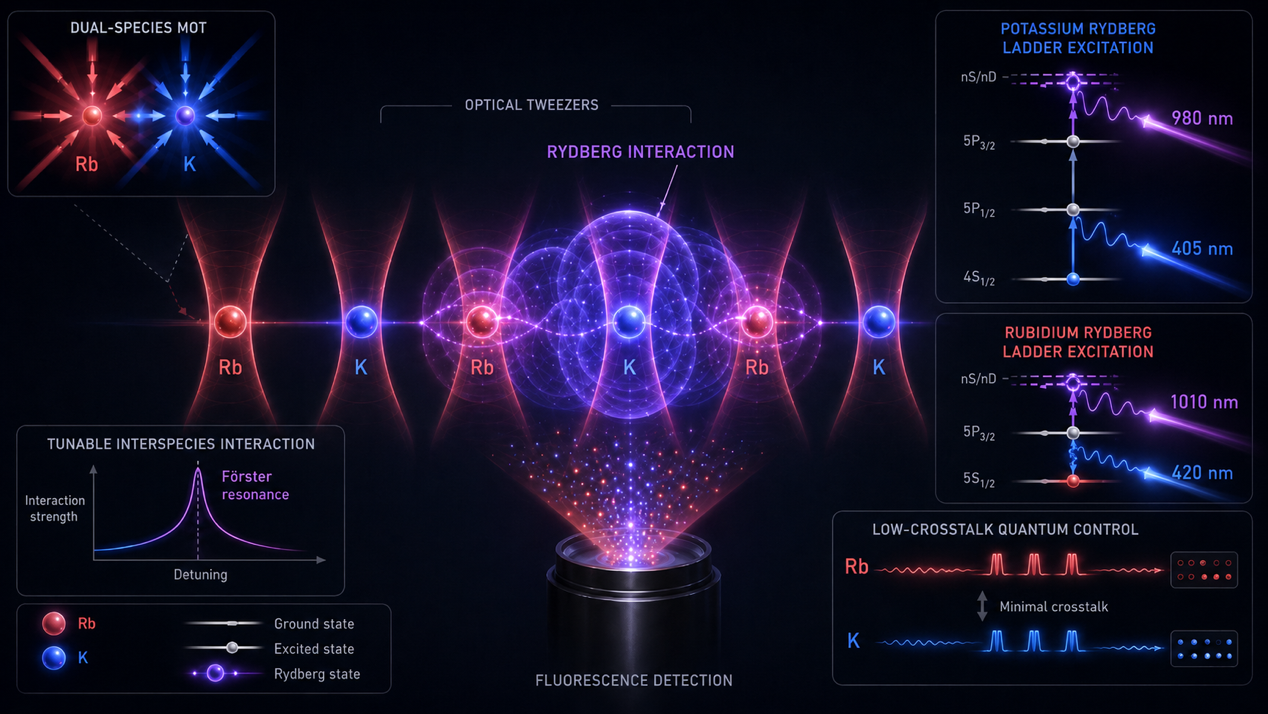
For potassium atoms, we develop ladder-type Rydberg excitation driven by 405 nm and approximately 980 nm lasers, and combine it with a coexisting Rb-K cold-atom system. By simultaneously monitoring the fluorescence of Rb and K magneto-optical traps, we can observe how K Rydberg excitation affects the Rb atom number and loss rate, thereby extracting heteronuclear interaction features that vary with the principal quantum number. Compared with single-element Rydberg arrays, heteronuclear atomic systems possess natural frequency distinguishability, which may reduce crosstalk and enable an architecture in which one atomic species serves as data qubits while the other serves as auxiliary measurement or control qubits.
The development of K-Rb heteronuclear Rydberg systems is relevant to quantum information processing and single-photon optical transistors, and K-Rb Rydberg pair states may provide strong long-range interactions. Related theoretical studies also predict strong Forster resonances in K-Rb systems, making them suitable for long-range energy transfer and entanglement generation. More broadly, dual-species Rydberg platforms have become an important direction in international quantum technology. Rb-Cs dual-species Rydberg arrays have demonstrated heteronuclear Rydberg blockade, interspecies quantum-state transfer, Bell-state generation, and QND measurements using one atomic species as an auxiliary measurement system. These results highlight the advantages of dual-species architectures for low-crosstalk control and mid-circuit readout. Rb-K optical tweezer systems are also becoming an actively pursued experimental direction internationally.
The forward-looking aspect of this project is that we are not only following the mature route of single-element Rydberg quantum arrays, but moving further toward controllable interactions between different atomic species. The K-Rb system has natural frequency distinguishability, which can reduce crosstalk during quantum operations and may enable a new architecture in which one atomic species acts as data qubits and the other as auxiliary measurement or control qubits. If a quantitative model of K-Rb heteronuclear Rydberg interactions can be established and further extended to single-atom-resolved control and optical tweezer arrays, this platform could open new experimental opportunities for quantum information, quantum simulation, controlled quantum measurement, and heteronuclear quantum interfaces.
Physics Building Room 307,308,309
Tel: 33295 or 42277
