|
Subproject2 categorized summary of research
outcomes
|
|
|
A.
Next generation optical communication technologies
Research highlights of our most important achievements
on optical communication researches can be summarized below
with the reference to the representative publication list
given in the beginning of Appendix II. Our full list of
publications can also be found in the later part of Appendix
II.
[Research Highlights]
I. Novel Optical Transmission & Processing :
(a)
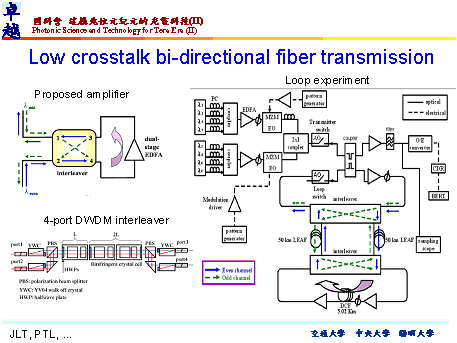
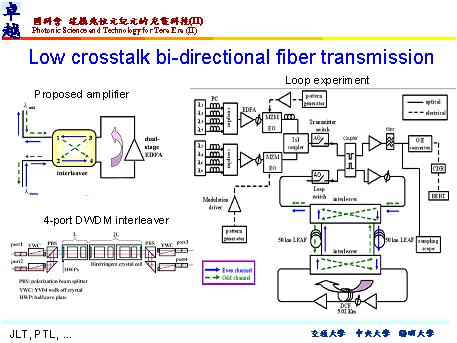
Bi-directional fiber transmission
and novel interleaver applications [1-5]
(b)
Novel
all-optical signal processing (slow lights, Optical 2R, PLC
ROADM ….)
[6-12]
(c)
Cost-effective/high-performance duobinary/DPSK/….
Transmission [13-19]
II. Novel Optical Networking Architectures & Technologies :
(a)
Hybrid wireless/fiber access networking [20-24]
(b)
Optical
access networking (PON, OCDMA, …)
[25-28]
III. Novel Fiber Devices and Laser Sources :
(a)
Complicated
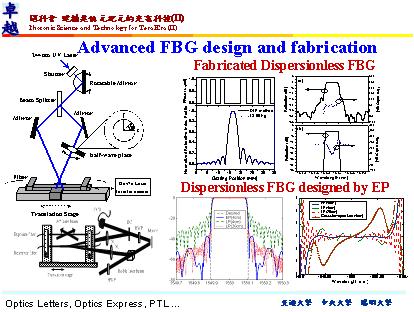
fiber Bragg grating devices: advanced design and
fabrication.
[29-32]
(b)
Novel
tapered fiber devices, fiber amplifiers and fiber lasers.
[33-40]
(c)
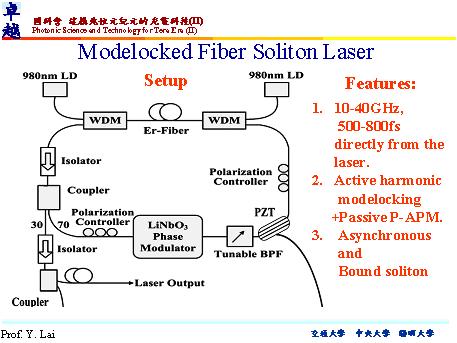
High repetition rate modelocked fiber soliton lasers
[41-43]
IV. Novel Theories & Applications :
(a)
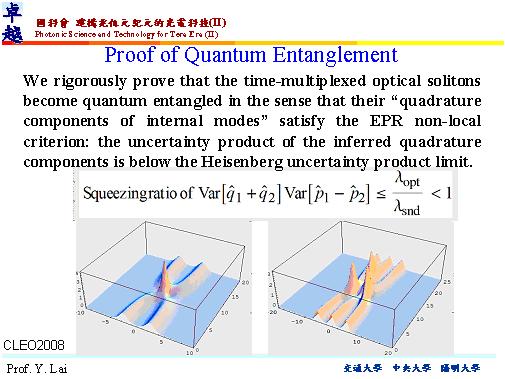
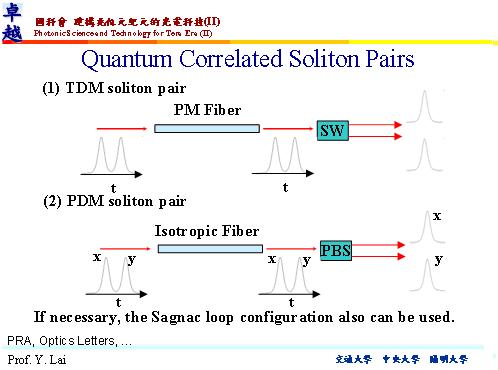
Quantum
squeezing and quantum entanglement of optical solitons
[44-47]
(The reference numbers above
and below are
refered to the
representative publication list given in the beginning of
Appendix II.)
Some explanations of these
achievements are given below:
I. Novel
Optical Transmission & Processing :
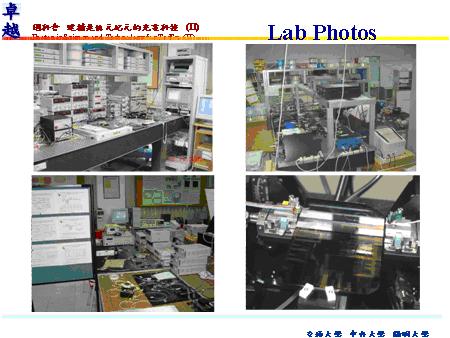
In terms of research infrastructure, we have
established the best fiber-circulating-loop testbed in
Other good examples are the studies on the DWDM
interleaver applications [4-5] and on the Planar-Lightwave-Circuit
(PLC) Reconfigurable-Optical-Add-Drop Multiplexer (ROADM)
[12]. We have studied the cascading transmission performance
of a PLC reconfigurable OADM module in a fiber circulating
loop. After
For optical transmission, we have developed several
efficient schemes for generating different modulation
formats (duobinary, DPSK, DQPSK, baseband digital/radio,
etc) by using only a single EO modulator. [16,18-19]
These schemes can provide economic solutions for
utilizing these modulation formats in practical
applications. We have also obtained good theoretical results
on the convergence of phase noises in DPSK transmission
systems by using novel phase noise averagers [15,17]. This
new technique is expected to greatly improve the DPSK
receiver performance.
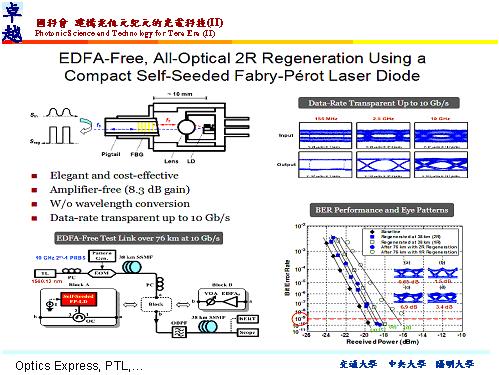
For optical signal processing, we have studied an
EDFA-free all-optical 2R regeneration scheme based on a
compact self-seeded Fabry-Pérot laser diode (SSFP-LD) [7-9]
[See the following figure for the setup]. The proposed 2R
regenerator achieves a straight line transmission at 10 Gb/s
over
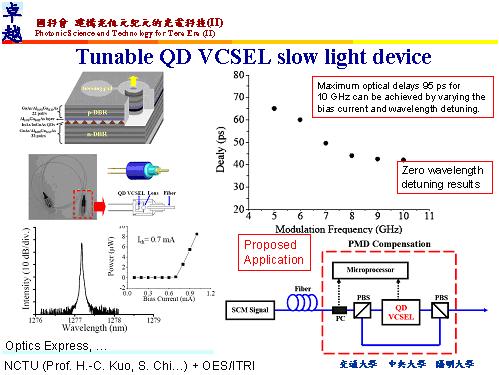
Recently we have also made important breakthrough on
the tunable QD VCSEL slow light devices. The achieved
bit-rate*delay-time product was the highest among the
similar semiconductor devices. Although still not sufficient
for optical buffer applications, they may find use in some
signal processing applications.
II. Novel
Optical Networking Architectures & Technologies :
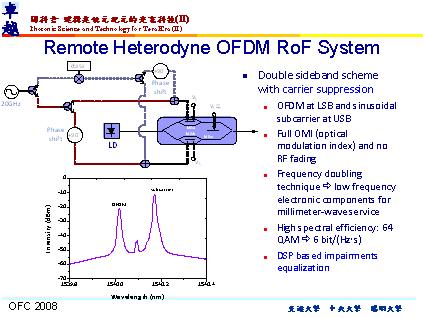
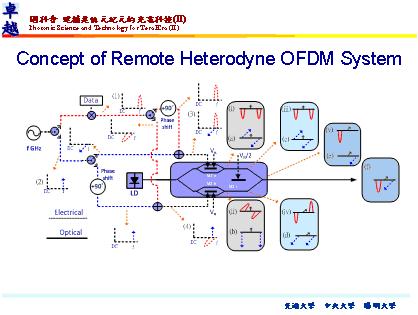
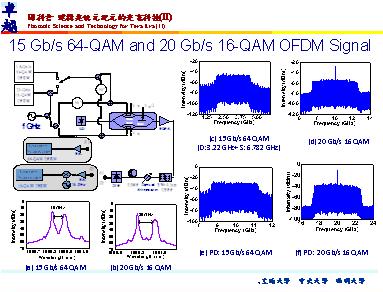
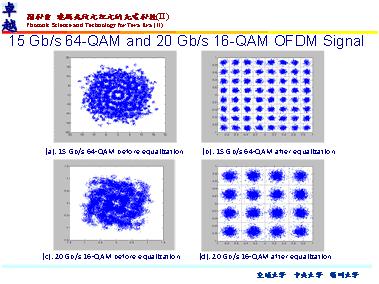
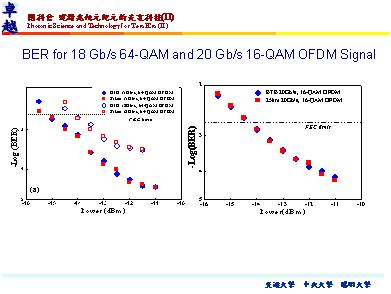
Examples of generated QAM OFDM signals at 15 or 20GHz
and their performance are illustrated in the following three
figures.
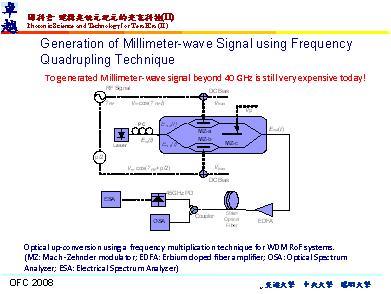
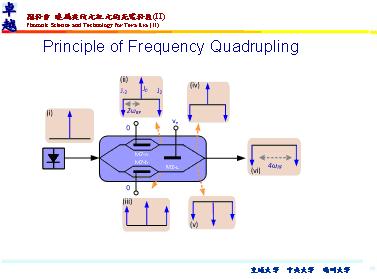
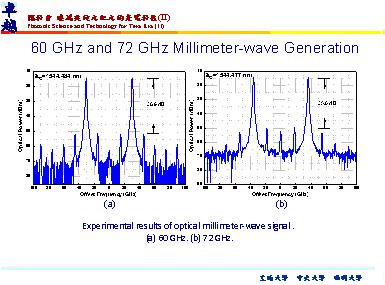
We have also further developed a frequency
quadrupling technique illustrated in the following three
figures and have successfully demonstrated the generation of
60 an 72 GHz microwave signals.
The above techniques have been employed to develop
new hybrid wireless/fiber access networking system [23-24].
One of the main advantages is that no narrowband optical
filtering is required.
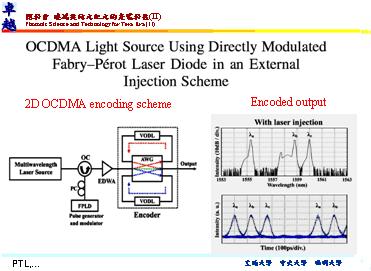
We have also developed several new techniques for other types of optical
access networks. They include the Passive Optical Networks
(PON) and the Optical Code Division Multiple Access Networks
(OCDMA) [25-28]. The following figure illustrates the
developed new 2D OCDMA light sources by external injection
of a semiconductor Fabry-Perot laser.
III.
Novel Fiber Devices and Laser Sources :
We have developed several new types of fiber devices,
fiber amplifiers, and fiber lasers [33-37] One example is a
novel tunable Er-doped fiber amplifiers covering S and C + L
bands over 1490-1610 nm based on discrete fundamental-mode
cutoff filters. [36] We demonstrate thermo-optically tunable
Er3+-doped fiber amplifiers covering S- and C + L-bands
(1490 ~ 1610 nm) using fundamental-mode cutoff filters
discretely located in a 17.5-m-long standard Er3+-doped
fiber. The maximum signal gains are measured to be 18.92 dB,
37.18 dB, and 15.19 dB with 980 nm pump power of 135 mW in
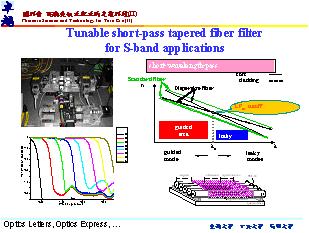
S-, C-, and L-bands, respectively. The principle of the
fiber filters is based on the fundamental mode cutoff
mechanism illustrated in the following figure:
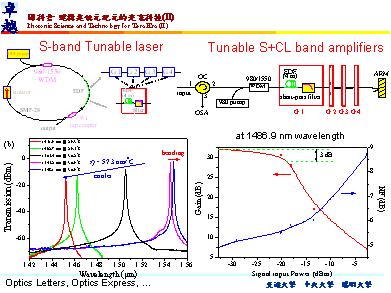
The achieved performance of the S-band amplifiers and
lasers are illustrated below. We demonstrate a widely
tunable fiber ring laser over 1451.9 ~ 1548.1 nm with tuning
efficiency as high as 57.3 nm/°C using a 16-m-long standard silica-based
erbium-doped fiber under 980-nm pump power of 208 mW. In
principle, such a technique can be applied to other fiber
laser systems to achieve shorter amplifying/lasing
wavelengths that can not be achieved by conventional
methods. In particular, the achieved lasing wavelength can
be as short as 1451.9nm, which should be the shortest lasing
wavelength of Er-fiber lasers reported to-date. Such a
wavelength range is of particular interest to biomedical
applications. This is why the paper is selected by the
Virtual Journal of Biomedical Optics.[33]
At NCTU we have established the best advanced fiber
Bragg grating (FBG) fabrication platform in
We have also developed several new types of
high-repetition-rate modelocked fiber soliton lasers and
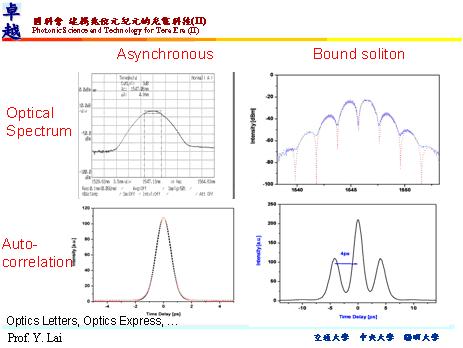
studied their laser dynamics.[38-40] In particular, we have
observed new bound soliton phenomena in a high-repetition
rate modelocked fiber soliton laser. The time separation of
the bound solitons can be modulated by adjusting the RF
driving power. This property should be useful for
implementing new applications with this new type of bound
pulse sources.
IV. Novel Theories & Applications :
We have
pioneered the development of the quantum theory for soliton
squeezing, correlation, and entanglement.[41-44] We show for
the first time that the solitons after nonlinear interaction
are indeed quantum mechanically entangled. This should open
new ways for generating quantum entangled light states.
B.
Next generation optical storage technologies
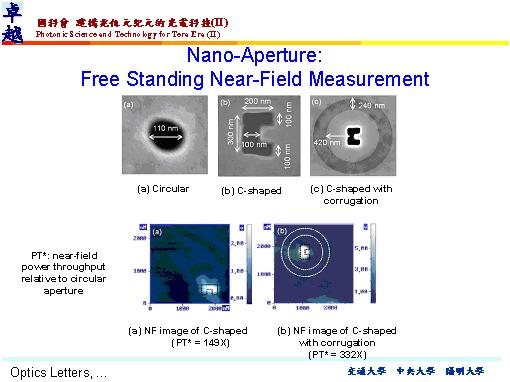
We have studied the power throughput enhancement
effects of nano-aperture[45, 50]. We presented a ridged
aperture encircled by a groove to allow the hybrid effect of
coupling surface plasmon resonance to a propagating wave.
This great improvement was demonstrated by its higher power
throughput of
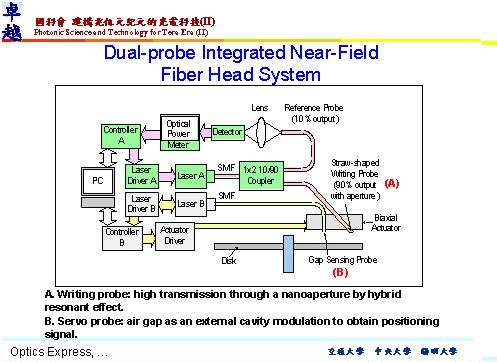
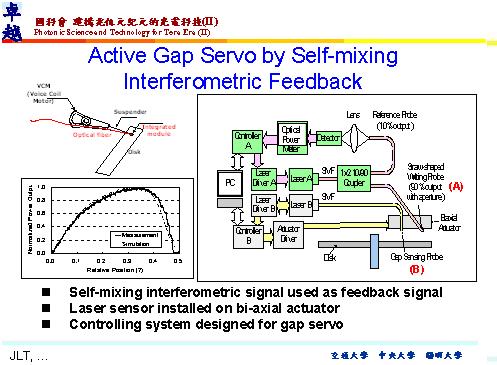
We demonstrated a novel fiber-based near-field
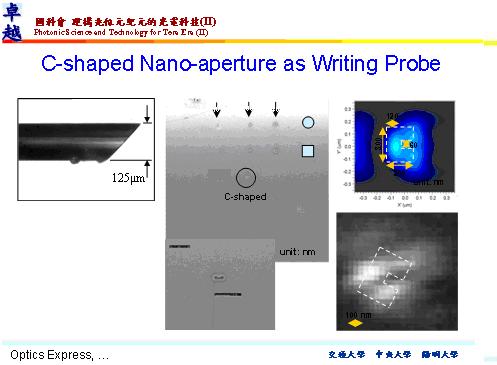
optical head consisting of a straw-shaped writing probe and
a flat gap sensing probe [46]. The strawshaped probe with a
C-aperture on the end face exhibits enhanced transmission by
a factor of 3 orders of magnitude over a conventional fiber
probe due to a hybrid effect that excites both propagation
modes and surface plasmon waves. In the gap sensing probe,
the spacing between the probe and the media surface
functions as an external cavity. The high sensitivity of the
output power to the change in the gap width is used as a
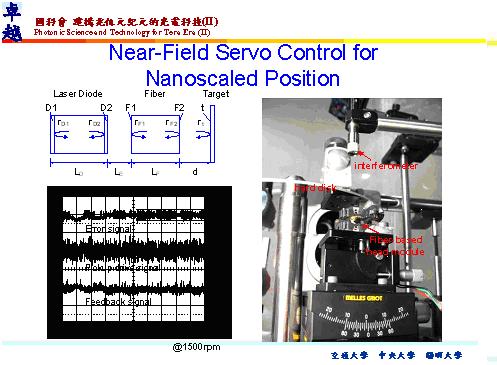
feedback control signal.[48] We characterize and design the
straw-shaped writing probe and the flat gap sensing probe.
The dual-probe system is installed on a conventional biaxial
actuator to demonstrate the capability of flying over a disk
surface with nanometer position precision.
[46]
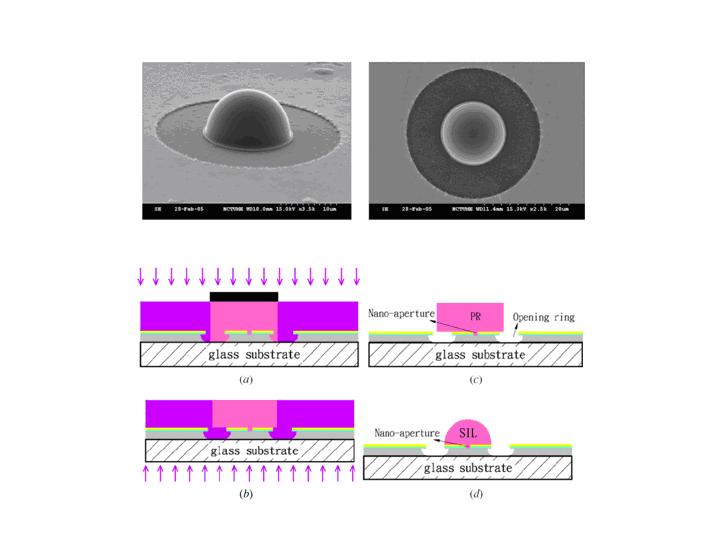
For the self-alignment process, two types of nano-aperture, circular and C
shapes, are fabricated by Focused Ion Beam (FIB) to combine
with
SIL/SSIL formed by thermal reflow.
Also, several novel micro actuators made of metal and polymer are
developed,
including a fabrication platform for three-dimensional
polymer microstructures. Furthermore, based on extrusion and
surface tension modulation techniques, a novel fabrication
method to fabricate SILs on suspended cantilever array is
successfully demonstrated.
From the measurements of
the power throughput and spot size, the
proposed self-alignment process is successfully verified.
For example, the φ15μm SIL/φ329nm
circular aperture component is calibrated and found to
enhance
throughput 168%, comparing with that of φ329nm
circular aperture alone.
Furthermore, the
throughput of 303nm×205nm C-shaped aperture/φ15μm
SIL component
can be enhanced 2443.8%, comparing with
that of φ148nm circular aperture alone. These results
verify the feasibility of the proposed
self-aligned process [51].
For Near-field flyability, computational results
show that grooved disks generate smaller pressure
than smooth disks since grooves can accommodate air
molecules and tune air pressure.[62] Further, flying higher makes
pressure magnitudes closer between grooved disks and smooth
disks in negative pressure area on slider bottoms. The
proposed computational method facilitates pickup head design
and improves head flyability during data read/write
[56-61].
Experiments are carried out to demonstrate that the proposed
controller performs better in flying height control than an
optimal sliding mode controller. Accordingly, the controller
can achieve stable flying height control in the presence of
certain frequency vibration of optical disks. The media in
near-field optical disk drives is usually made of glass or
polycarbonate, which may generate significant deformation
arisen from disk rotation. Using the advanced control method
developed in this study can maintain stable and constant
flying height, which is required in near-field data
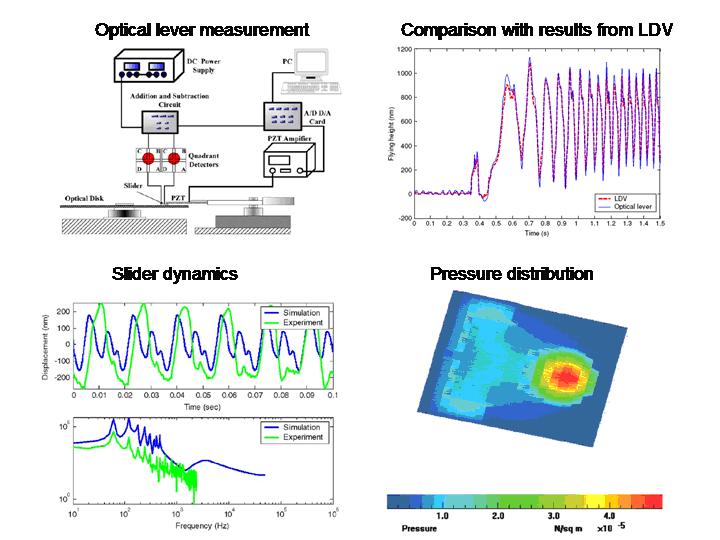
reading/writing. An optical lever method using
only
photo detectors for
measuring flying height
is applied to
the
flying head experiments.
The results are validated by
comparing with those
from laser Doppler interferometers (LDV).
|