In order to make nonmagnetic III-V's such as GaAs and InAs magnetic, one needs to overcome the low solubility limit of the magnetic impurity in the host III-V's. Low-temperature molecular beam epitaxy (LT-MBE) successfully produced dilute In1-xMnxAs and Ga1-xMnxAs epitaxial layers exceeding the solubility limit and suppressing segregations [H. Ohno et al., Nature 408 ,944 (2000)].
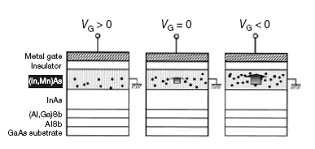
Field-effect control of the hole-induced ferromagnetism in magnetic semiconductor (In,Mn)As field-effect transistors. VG controls the hole concentration in the magnetic semiconductor channel (filled circles). Negative VG increases hole concentration, resulting in enhancement of the ferromagnetic interaction among magnetic Mn ions, whereas positive VG has an opposite effect. The arrow schematically shows the magnitude of the Mn magnetization. The InAs/(Al,Ga)Sb/AlSb structure serves as a buffer relaxing the lattice mismatch between the structure and the GaAs substrate
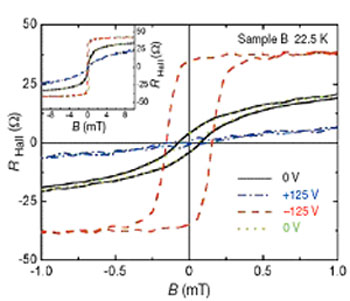
RHall versus field curves
under three different gate biases. Application of VG=0, +125 and -125
V results in qualitatively different field dependence of RHall measured
at 22.5 K. When holes are partially depleted from the channel (VG=+125
V), a paramagnetic response is observed, whereas a clear hysteresis
at low fields (<0.7 mT) appears as holes are accumulated in the channel
(VG = -125 V). Two RHall curves measured at VG =0 V before and after
application of ±125 V are virtually identical. Inset, the same curves
shown at higher magnetic fields.
However, we should notice that E-field control of ferromagnetism can work well only at low temperature. The transition temperature in the III-V ferromagnetic semiconductors is 110K, still below room temperature. For crossing temperature limit, many research focus on not only theory calculating, but also new matter. For example T. Dietl and H. Ohno use mean field theory calculate Curie-temperature with a lot of matter [T. Diett et al., Science 287, 1019 (2000)], and find Curie-temperature of GaN and ZnO are above room temperature. But there is only an expectation and a lot of groups still work on now.
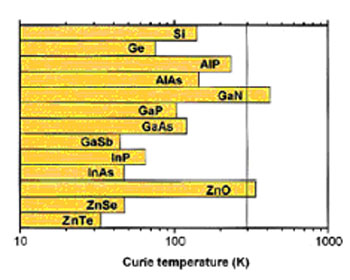
Computed values of the Curie temperature Tc for various p-type semiconductors containing 5% of Mn and 3.5*1020 holes per cm3
Saki Sonoda et al. showed that the (Ga,Mn)N films having ferromagnetic behaviour at room temperature were successfully grown on sapphire(0001) substrates by molecular beam epitaxy using ammonia as a nitrogen source. [S. Sonoda et al., J. Cryst. Growth 237-239, 1358 (2002)] Their result was that the magnetic-field dependence of magnetization of a (Ga,Mn)N film at 300K was ferromagnetic, while a GaN film showed Pauli paramagnetism-like behaviour. And they estimated that the Curie temperature of a (Ga,Mn)N film could be 940 K. Although the high Curie temperature of the result they get is controversial, it gives us a hint that the room temperature DMS isn’t impossible.
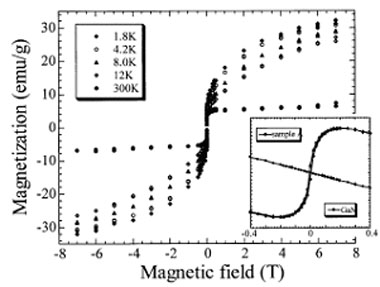
Magnetic-field H dependence
of the magnetization M (M-H curve) of (Ga,Mn)As at 1.8, 4.2, 8.0, 12
and 300K up to 70 kOe. The inset represents M-H curves of (Ga,Mn)As
and GaN film at 4.2K including the contribution of the diamagnetic behavior
in the sapphire substrate.
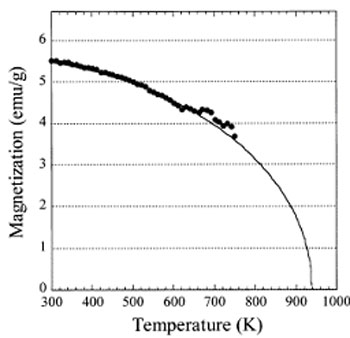
Temperature T dependence
of the magnetization M (M-T curve) of (Ga,Mn)As at 0.1 T.